Motility in the Colon
Image ID: 6482
 Pricing
Hi-Resolution
13.1 MB EPS
Good For All Uses:
Print, Electronic and Digital
Please Note: Specialized programs, such as Adobe Illustrator, are needed to use EPS files.
Lo-Resolution
2677x1653 px
296 KB
RGB JPG
Best For:
Electronic and digital use: (e.g. websites, PowerPoint, broadcast, VHS, CD/DVD)
Netter ad clinical key
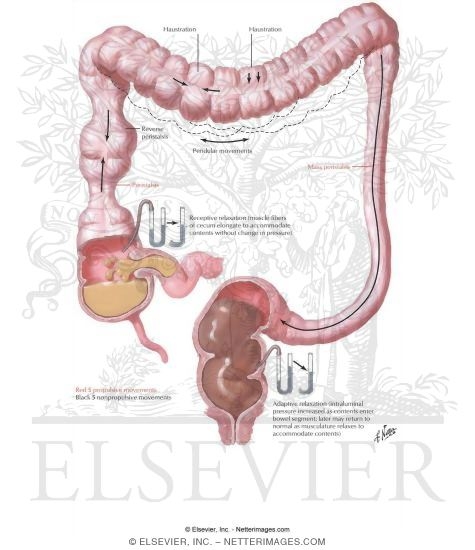
Motility in the Colon
Figure 22.8 • Motility in the Colon – The colon is specialized for storage, and when bands of longitudinal muscle (taenia coli) contract, they form haustra. This is called segmental propulsion, which is very slow, and allows time for additional sodium and fluid absorption (colonic salvage). The slow movement dries out the chyme, producing feces. Several times a day mass movements will occur, creating peristaltic movements that force the chyme/feces toward the rectum. Factors that increase intestinal motility can cause diarrhea, by minimizing formation of haustrae and increasing mass movements.

The preview images do not contain enough pixels to make small type legible on screen, however,
the actual delivered images will contain labels that are clearly legible. (view PDF preview)
  This Illustration was Published In
Netter's Essential Physiology
Author: Susan E. Mulroney, Adam K. Myers
Chapter: Motility Through the Gastrointestinal Tract
Page: 263
Netter's Gastroenterology
Author: Martin H. Floch, MD, Neil R. Floch and Kris V. Kowdley
Chapter: Colon, Rectum, and Anus
Page: 430
Netter's Atlas of Human Physiology
Author: John T. Hansen, PhD and Bruce M. Koeppen, MD, PhD
Chapter: Gastrointestinal Physiology
Page: 162
 
If you can see this message, you need to update your Flash Player.
poster ad Elsevier

    TERMS OF USE    PRIVACY POLICY    HELP    CONTACT US     ABOUT US

BOOKMARK THIS PAGE: Digg It!  Add to del.icio.us  Add to StumbleUpon  Add to Reddit  Add to Technorati  Add to Furl  Add to Netscape